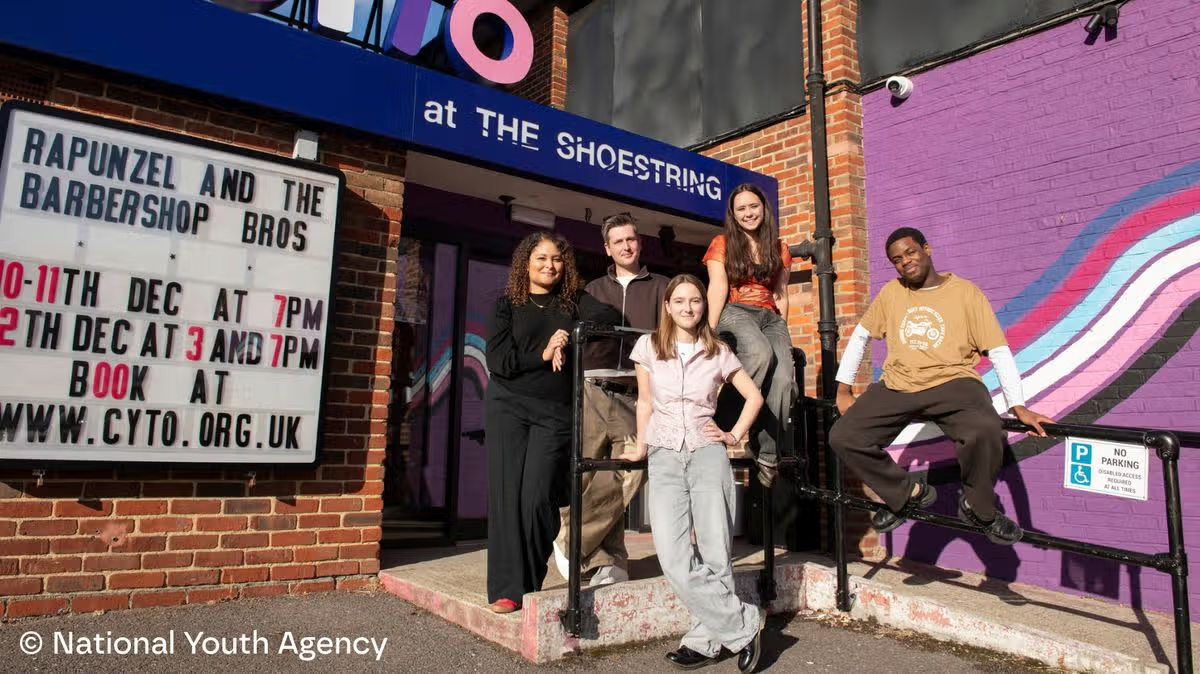
Inside a theatre tucked away down a suburban street in South London, three young people are talking about Shakespeare.
“I found I could relate to Othello,” 17-year-old Kristian Michael Swaby says. “The idea of gossip culture, things being said behind your back, the idea of someone who is close you but not close to you. And it’s a play that has racial themes.”
Fellow actors Zoe Pilbeam, 17, and Eleni Petro, 15, are also talking about how the Croydon Youth Theatre Organisation (CYTO) has changed their lives. “I literally couldn’t speak before I came here,” Zoe says. “I physically couldn’t speak – my voice broke every time. I’m still terrified of performing even though I love it so much. But no-one is going to judge you here and I’ve found my voice.”
Outsiders might not have this image of Croydon, a place too often hyped and stereotyped by social media, and weighed down by national statistics. The most deprived borough in South London until recently also had the painful label ‘knife crime capital’ – which seemed to be personified by the murder of teenager Elianne Adnam, stabbed on the bus to school in 2023.
Now, thanks to a determined, multi-agency effort by its local communities, MPs, charities, the London Mayor and neighbourhood police, Croydon is climbing the league tables. And while some of the strategy is highly visible – like the pilot announced this week by local MP and policing minister Sarah Jones that will crack down on street crime – some of it is also happening quietly, behind the scenes, on the back streets of South Norwood.
After six decades serving the community, CYTO is embedded in generations of lives. In 2022, the organisation secured a 30-year lease of the Shoestring Theatre via a Community Asset Transfer, meaning 120 young people have chance to be part of six shows a year, alongside creative workshops for hundreds more. In May, the theatre company received the London Youth Arts ‘Not-for-Profit of the Year’ Award at the annual Prestige Awards.
We are visiting CTYO to mark National Youth Work week – which this year is spotlighting youth workers as part of the National Youth Agency’s ‘Where Futures Begin’ campaign.
“I’m a theatre director – I see my job as storytelling and connecting that to young people,” says CYTO’s Artistic Director Andrew McPherson. “But I think youth work is about providing opportunities for young people to be heard. Our job is to step to the side and facilitate.
“Alongside all the fun that’s had, there’s also a lot of accidental learning. Young people acquire all the core skills for employability – self belief, self-management, team work – all while poetry is falling out of their mouths with ease. Our members have gone on to become better barristers and better mums, brilliant poets and doctors who say they relate better to their patients because of their experiences here.”
In the blizzard of statistics around Croydon, there is one that is often missed. Despite it being one of the capital’s youngest boroughs, under Austerity, Croydon’s youth services were among the most cut and outsourced in the country – something one of its four MPs, Natasha Irons, came into politics to tackle.
“Between 2010 and 2023,” the Labour MP for Croydon East says, “local authority spending on youth services fell by 73 per cent across the country. We lost more than 1,000 youth centres and over 4,500 youth worker roles nationwide. We shouldn’t be surprised there is a mental health crisis among young people – we have taken away the safe spaces young people trusted. If we want to ask them to get off their phones, we need to give them somewhere to go. We need safe places for kids who don’t have the luxury of failure, whose parents can’t afford to pay for clubs.”
Irons says youth work is also key to one of her biggest caseloads as an MP – young people’s mental health. “Some of that comes from Austerity, the stress on a family who can’t keep a roof over their heads, or the stress that being in temporary accommodation feeds into a child’s life,” she says. “But we’ve also got more children staying in their bedrooms scrolling on phones, and lacking the confidence to go out and negotiate the world.”
Soon after becoming an MP, Irons used a parliamentary device called a ‘Ten Minute Rule Bill’ to demand it become compulsory for councils to protect youth services. Now, she welcomes the government’s National Youth Strategy, which aims to give 500,000 young people access to a trusted adult, and to deliver 250 youth centres and 50 Young Futures Hubs across the country.
The National Youth Agency welcomes the national change in direction, but say there is more to do. “Every young person deserves a safe place to go, a chance to explore new interests and someone in their corner,” says Abbee McLatchie, the NYA’s acting CEO. “The government’s recent announcement of £17.8 million for the Youth Sector Development Fund and funding for 1,000 youth work specialists is a welcome boost. But the job isn’t done.
“We need a stronger, sustainable youth sector that can meet demand. That means a stronger statutory duty on local authorities to make sure their local offer is up to scratch – training up those already working in the sector and better recognition of youth workers’ skills so that no young person who needs a youth worker is left behind.”
For the three young people we meet at CYTO already rehearsing for the annual Christmas panto, Rapunzel and the Barbershop Bros, the journey has already been profound. Kristian has just won the Creative Expression award at the inaugural Croydon Youth Awards, and is now following in the footsteps of actors like Tom Holland at the BRIT school – a future that would have been unimaginable before coming here.
“It’s safe to say that if you talk to anyone who knew me before I came here, that I’ve changed for the better,” Kristian says. “It’s not just given me confidence artistically, but confidence with who I am and who I want to be. I turn up now.”
Eleni nods: “Here we can be completely ourselves.” Zoe says: “In year 7, I hated school so much, but coming here on Saturday and Sunday kept me going. School felt like a restricted suffocating place, but this was different.” Three thoughtful young people, who fluently discuss the mobile phone ban, and votes at 16, as well as sometimes feeling unsafe on the streets after dark – this is the generation who will see Croydon finally shake off its difficult recent past.
Their MP looks across the darkened theatre. “When I was growing up, we had a youth club,” Irons says. “It was a bit rubbish, but at least it was ours. That’s why I got into politics, because I want to see kids like me growing up with the same opportunities. Young people are more connected than ever before, but they are also more lonely than they have ever been before. They need more face-to-face places like this, near to where they live.”