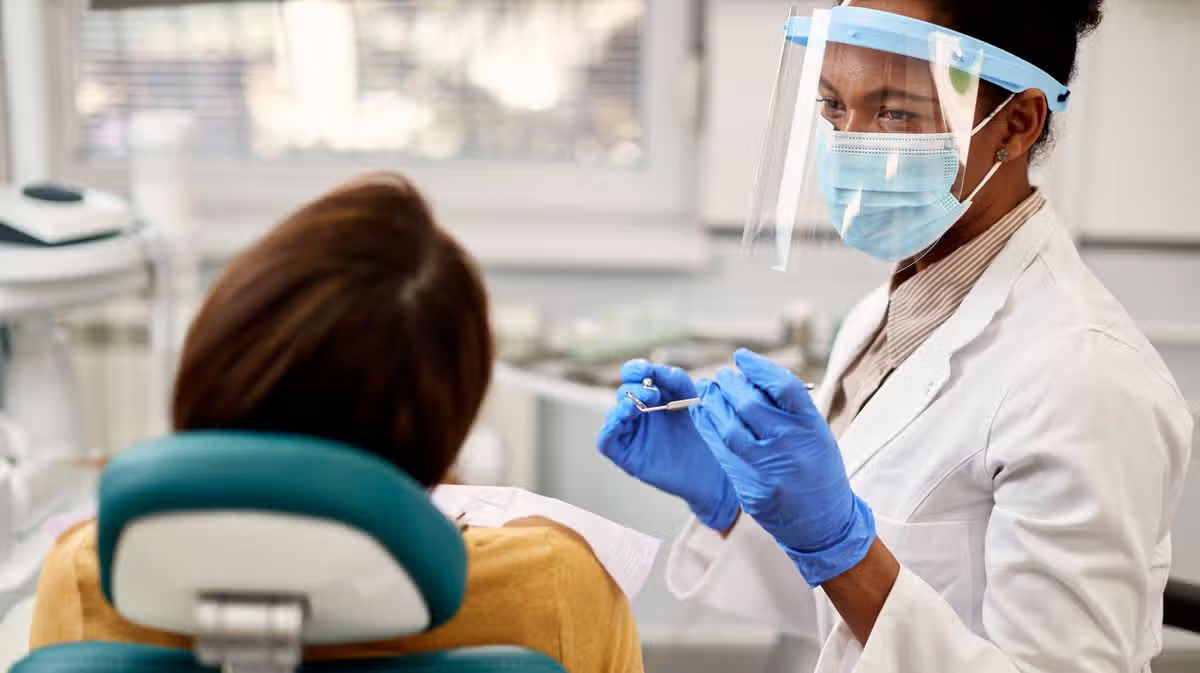
An investigation for the Mirror’s Dentists for All campaign reveals that in the worst-hit areas only one in five adults are seeing an NHS dentist

New research has revealed Britain’s worst dental deserts(Image: Getty Images)
Just one in five adults are accessing an NHS dentist in some parts of the country, an investigation has shown.
Britain’s worst dental deserts have been revealed in new research by parliamentary constituency which lays bare the nation’s oral health crisis. Analysis for the Mirror ’s Dentists for All campaign shows that in many parliamentary constituencies fewer than 30% of adults are seeing an NHS dentist while in the worst dental desert it is 20%.
It comes amid an access crisis that has seen many practices close their NHS books to new NHS patients and push them to become private patients to pay inflated fees.
To see more of the stories you love from The Mirror and to find them easily in Google then make us your preferred source. Free and easy-to-do, just click on the link here to find more from The Mirror at the top of your feed.
Latest data shows on average 40% of adults in England saw an NHS dentist in the last two years. Peterborough was the parliamentary constituency with the worst dentistry access problem for adults where only 20% had their last NHS check up.
In both Plymouth Sutton and Devonport and Plymouth Moor View constituencies it was just 23%. The South West of England was the region with the biggest NHS access problem. Eddie Crouch, chair of the British Dental Association, said: “On paper NHS dentistry is meant to be a universal service. In the real world it’s cash-starved, and access is pure postcode lottery. Millions are unable to secure they care they need. That won’t change until government fix and fund it.”
Adults with generally healthy teeth should see a dentist every two years and children every 12 months. The research by Unity Trust Bank also shows Scotland has much more dentists than England when population size is considered. Separate data shows areas where there are the fewest dental practices to care for the population with Stoke-on-Trent South faring worst.
Colin Fyfe, CEO of Unity Trust Bank, said: “Dental health is a central component of physical and mental wellbeing. Dental pain and discomfort can be all consuming, infiltrating a person’s entire experience of life until they are able to get the care they need. This research helps identify where that need is greatest.”
Unity Trust Bank brands itself as a “social impact lender” which provides finance to help set up dental surgeries as well as GP practices and pharmacies. Its report into access to dentists drew on data from the NHS Business Services Authority. Andrew Pakes, Labour MP for Peterborough, said: “This isn’t just people struggling to find NHS treatment. It is also the cost to all of us, as dental problems build up and become much more serious and costly to deal with.
“This report is an SOS call on the state of NHS dentistry. Much more urgent action is needed to fix the broken NHS dental contract and boost the number of practices taking on NHS patients.”
Labour has made progress on child access to NHS dentists with latest data showing 60% saw one in the last year, up from 56% in June 2024. Child courses of treatment increased by 7% to 13 million after the government introduced incentives to prioritise child emergency cases.
But in 70 seats, less than half of children have seen an NHS dentist in the previous 12 months. Those where only around 40% of kids had seen an NHS dentist were Hackney in east London, as well as areas in the South West such as Glastonbury, Taunton, Wellington Bridgewater and Yeovil.
It comes a week after a report by consumer group Which? found Brits unable to get an NHS dentist are being overcharged by private practices by thousands of pounds. It also uncovered botched procedures, overcharging and patients unwilling to complain due to fears of losing access to a dentist.
The research looked at where the fewest dental practices were, including those that still see some NHS patients as well as those that have gone fully private. On average in England there are 15.78 practices for every 100,000 residents but in 55 constituencies this is fewer than ten. Stoke-on-Trent South has the lowest overall provision in England, with just 5.17 practices per 100,000 people – around a third of the English average. This is followed by Bristol South with 6.48, Sherwood Forest with 6.52 and Selby in north Yorkshire at 6.64.
When looking only at practices that still see some NHS patients, England has much fewer than Scotland given its population size. The analysis shows Scotland has 17.83 NHS dental practices per 100,000 residents compared with 13.04 in England – around 37% more. The Unity report combined adult and child access rates to produce a combined league table of the constituencies with the lowest access to dentistry.
The South West accounts for six of the eight constituencies which appear among the worst-performing places in England for both adult and child dental access. In Glastonbury and Somerton, Taunton and Wellington, Bridgwater and Yeovil, less than 30% of adults had seen an NHS dentist in the previous two years and only 40% of children had seen one in the previous year.
NHS dental funding for England remained at about £3 billion for more than a decade under Conservative governments, failing to keep pace with inflation and population growth. By the time the Tories left power, the funding was only enough to fund care for half the population. The BDA calculated that they had overseen a £1bn real terms funding cut.
When Labour came to power it increased the annual budget to £3.5bn for 2024/25. The BDA says an extra £1.5bn is needed to rescue NHS access for all who need it. Labour has committed to reforming the NHS dental contracts, which sees dentists make a loss on some more complex appointments. However it is unclear whether it will commit the extra funding needed.
A spokesman for the Department of Health and Social Care said: “This government is fixing NHS dentistry after a decade of decline. We have improved access to urgent dental treatment by prioritising patients with the greatest need, and millions of additional courses of treatment have been delivered. But there is still more to do – especially to increase the dentistry workforce – and that is why we’re rolling out more dentistry school training places in areas which need them and cutting red tape to allow qualified dentists to practise.”
Health Editor Martin Bagot
I’ve been reporting on the collapse in access to NHS dentists for years but this new data shows just how acutely the problem is being felt in some areas. The fact that as few as one in five adults and just 40% of children are getting their regular NHS check-ups in some areas shows that we are storing up a major health crisis.
Regular check-ups are vital for maintaining good oral health and preventing more major dental work – like fillings, root canal treatments and extractions. My mum was a dental nurse and I always remember her stressing that nothing the dentist can do in terms of crowns, veneers or dental implants is better than your natural enamel teeth.
Once you start losing them, the dental fixes will always be inferior to what you’ve lost. When young adults in particular lose teeth it can have a big impact on their confidence and even their employability. Poor oral health can affect people’s life trajectories in ways not captured by any official statistics.
Labour has rightly targeted extra appointments at the patients with greatest need who need most work done, but without fundamental reform of the NHS dental contract many more patients will need such emergency appointments. Regular check-ups are key for prevention and universal NHS access will only return if we as a country pay more for dentistry.
The £3.5bn dental budget is a drop in the ocean compared to the overall NHS budget of over £200bn in England. A relatively modest funding boost here will go a long way. After all, you get what you pay for and right now, we are not paying enough to maintain the oral health of the nation.