We must remove the profit-at-all-costs motive from what is essential service on which all of us depend, yet none of us have any choice over who we buy from, argues Graham Hiscott

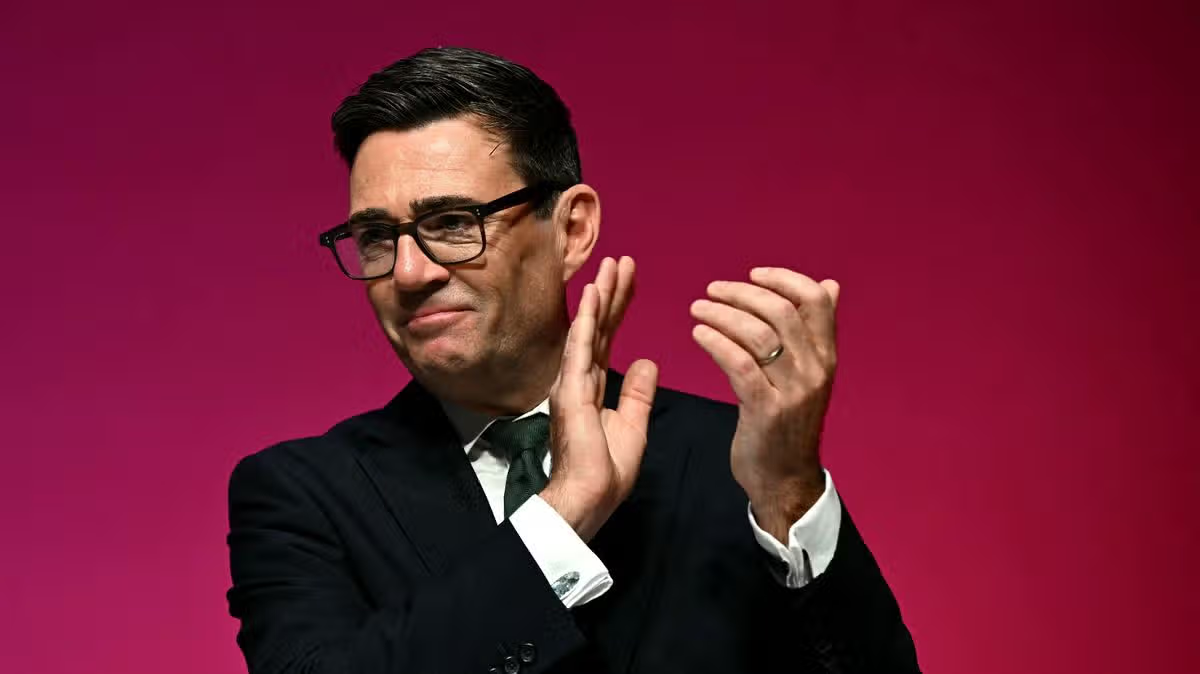
Andy Burnham has advocated for more public control of utilities (Image: POOL/AFP via Getty Images)
There was a time when most people didn’t have a strong view either way about water firms, as long as the taps ran and the loo flushed. Both still do, but what’s changed is the anger provoked by a privatised industry now drowning in debt, with waterways clogged with sewage, yet failing bosses still picking up rich rewards.
And the lightning rod for so much fury has been crisis-stricken Thames Water. Britain’s biggest water company is nearly £20billion in debt and battling to stay afloat.
It has been a slow car crash, with its biggest creditors – who face losing big time if Thames goes under – desperately seeking approval from industry regulator Ofwat for what’s been dubbed a rescue plan. The alternative, as it stands, is that Thames enters a “special administration regime” (SAR), a form of temporary nationalisation.
Pressure is mounting on either sides – creditors and the government – hence reports in the past week claiming PM Andy Burnham had shelves plans to put the firm into administration. Insiders have privately rubbished the idea. Another suggested the creditors wanted guarantees before they’d put another £2bn into Thames to keep it going.
Yet Mr Burnham is right not to rush into any decision, given the fallout, both for the reputation of the new government as well as economically. Before taking over, the “King of the North” indicated his support for bringing water companies under greater public control, starting with Thames.
Critics are quick to quote research claiming the bill for nationalising the industry could be at least £100bn. However, that largely ignores the parlous state of the industry and the threadbare finances of many suppliers once you take into account just how much they owe.
Dieter Helm, Professor of Economic Policy at the University of Oxford and Fellow in Economics at New College, Oxford, used a recent blog to destroy many of the arguments put forward by Thames Waters’ advisors. To be clear, Professor Helm isn’t backing nationalising Thames Water – far from it. “Long gone are the days when governments had the competence to run major companies”, he says.
However, he also debunks the £100bn figure – and indeed suggestions it could be £144bn – as they ignore the full costs that could be recovered when water firms that enter SAR and then sold to new buyers. “To be clear, the economic number is not £100bn or £144bn, but £0,” he writes.
Mr Burnham has advocated a “new economic model” that puts life’s essentials back under public control” Yet greater public control of Thames Water – and others – doesn’t have to mean the taxpayer becoming long-term owners. What it should mean is taking the profit-at-all-costs motive being removed from what is essential service on which all of us depend, yet none of us have any choice over who we buy from.
However, there is a third way between full state ownership and full private ownership. One is a hybrid, or public-private Partnership (PPP) model. These can take different forms, but can include governments retaining ownership of physical infrastructure assets while a private company finances, maintains, and operates the system. In the case of water, the taxpayer owns the pipes, sewage plants and the like, while private firms run the network, with a reasonable regulated return (profit margin) built in.
Public control could take other forms, including having a say over how water companies are run to ensure it’s for the good of customers and the environment. That’s not just from the sidelines but even having a seat on the board, and a veto over duff decisions.
From my experience, water companies are still tone deaf to the criticism heaped on them. Perhaps having real customers sat over the table from bosses – and able to decide on fat cat pay – would focus their mind.
Whatever the solution, no one believes the current system works, with privatisation of the water industry proving a disaster (unless you’re among those previous owner who made a fortune out of it).
In the case of Thames Water, Mr Burnham could simply decide to run down the clock until it finally runs out of money and goes bust. To be clear, services to customers would be protected. But bold action is needed to ensure it doesn’t end up being business as usual. Change is long overdue.