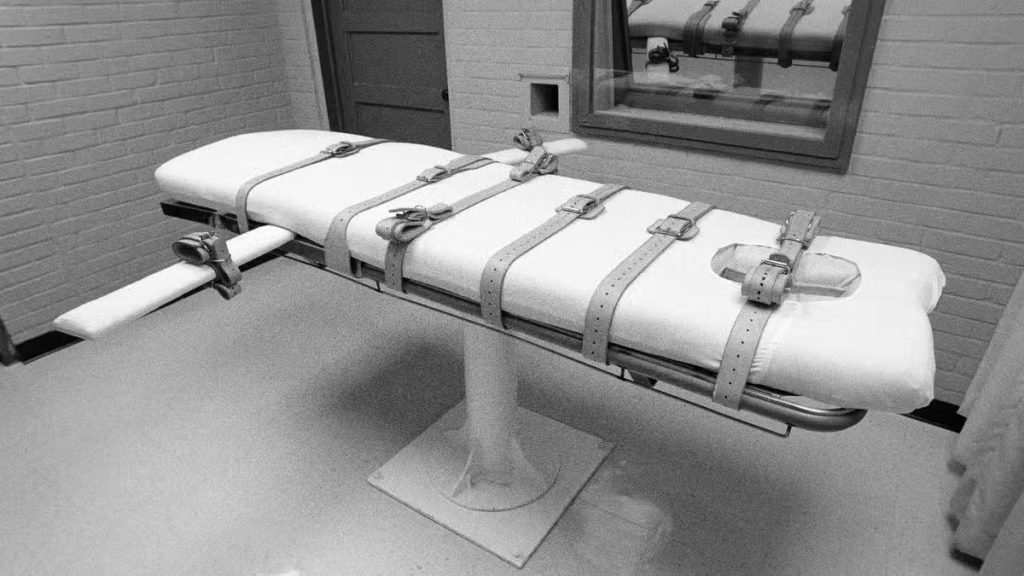
America loves to call itself the greatest country on Earth, a beacon of freedom, a defender of human rights, and a nation built on liberty, justice, and the rule of law. Yet across large parts of that same country, states still believe it has the moral authority to strap a human being to a gurney, pump poison into their veins, and call killing justice.
And sometimes, as Tennessee demonstrated with Christa Pike, it cannot even carry out that grim business without turning death into a horrifying spectacle.
Pike committed an appalling crime. At 18, she took part in the torture and murder of 19-year-old Colleen Slemmer, whose suffering should never be diminished and whose family has endured a loss no sentence can repair. But the brutality of a crime does not absolve a supposedly civilised state from examining its own behaviour.
This morning, officials administered pentobarbital to Pike, then a second dose when the first failed, yet she remained alive; her lawyers said she was unconscious, still had a heartbeat and could be heard snoring, before the woman Tennessee had spent decades preparing to execute was taken to hospital so doctors could preserve the life the state had just tried to extinguish.
There, in one grotesque episode, is the obscenity at the heart of capital punishment: a government claims killing demonstrates the value of life, employs people to carry it out, watches the condemned person fail to die and then summons doctors to save them.
Supporters will say Pike deserved no mercy and understandably point to Slemmer, asking where the mercy was for her. Others will argue that some crimes are so monstrous that death is the only proportionate punishment. But America’s justice system, like every justice system, makes mistakes.
Since 1973, 203 people sentenced to death have been exonerated, roughly one for every eight executions carried out during the modern era, while a landmark academic study estimated that at least 4.1% of defendants sentenced to death were innocent. It should terrify anyone comfortable with capital punishment, because it combines human fallibility with the one sentence from which there can be no recovery.
I have seen this machinery close up. I visited death row and sat opposite Richard Glossip in Oklahoma, a man given nine execution dates and three final meals, who spent years knowing officials could arrive to kill him, only for the US Supreme Court eventually to overturn his conviction after finding prosecutors had failed to correct false testimony from their crucial witness.
He was released on bond this year while awaiting a new trial. America came terrifyingly close to killing a man whose conviction its own highest court ultimately decided could not stand.
I have interviewed executioners too, ordinary people required by the state to participate in ending another human life, and those I spoke to carried regret about their role years afterwards. The damage spreads far beyond the condemned prisoner, reaching guards, witnesses, relatives and those asked to operate this machinery of death.
Then comes the taxpayers’ argument: why should decent people pay to keep murderers alive for decades? Because capital punishment can cost considerably more. Death penalty cases require longer trials, specialist lawyers, additional hearings and years of appeals, precisely because the consequences of getting it wrong are permanent, and without those appeals, some innocent people already sentenced to die would never have walked free.
Nor is life imprisonment a soft option. Take away somebody’s liberty until death, and you take almost every ordinary freedom for granted: where they sleep, when they leave a room, whether they walk down a street or close their own front door, while parents die, children grow older, and decades disappear behind concrete and steel.
Under Joe Biden, federal executions were halted after then Attorney General Merrick Garland imposed a moratorium in 2021, and Biden later commuted 37 of the 40 federal death sentences then in place to life without parole. Under Donald Trump, the direction has been reversed, with his administration restoring and strengthening the federal death penalty.
The history makes that especially chilling. In 1989, as New York reeled from the Central Park jogger attack, Trump paid for full-page newspaper advertisements demanding: “Bring Back The Death Penalty. Bring Back Our Police.”
The five Black and Latino teenagers convicted in that case were later exonerated after another man confessed and DNA evidence supported his account. Their convictions were vacated in 2002. That should stand as a permanent warning against the certainty with which politicians demand irreversible punishment before the justice system has established the truth.
Britain should remember its own shameful history whenever anyone suggests bringing capital punishment back. Timothy Evans was hanged in 1950 and later received a posthumous pardon. Derek Bentley went to the gallows in 1953 before his murder conviction was quashed decades later.
Police make mistakes. Prosecutors make mistakes. Witnesses lie. Evidence is missed. Juries can convict the innocent and judges can preside over trials later found unsafe. A justice system capable of error has no business claiming the certainty required to kill. A prison door can be opened and a conviction overturned, allowing a wrongly imprisoned person to step back into daylight and attempt to rebuild what remains of a stolen life.
But once the state has killed an innocent person, there is no appeal worth hearing, no pardon capable of repairing the damage and no politician able to undo what has been done.
That is the terrible arrogance at the heart of the death penalty: fallible human beings giving themselves an infallible punishment.