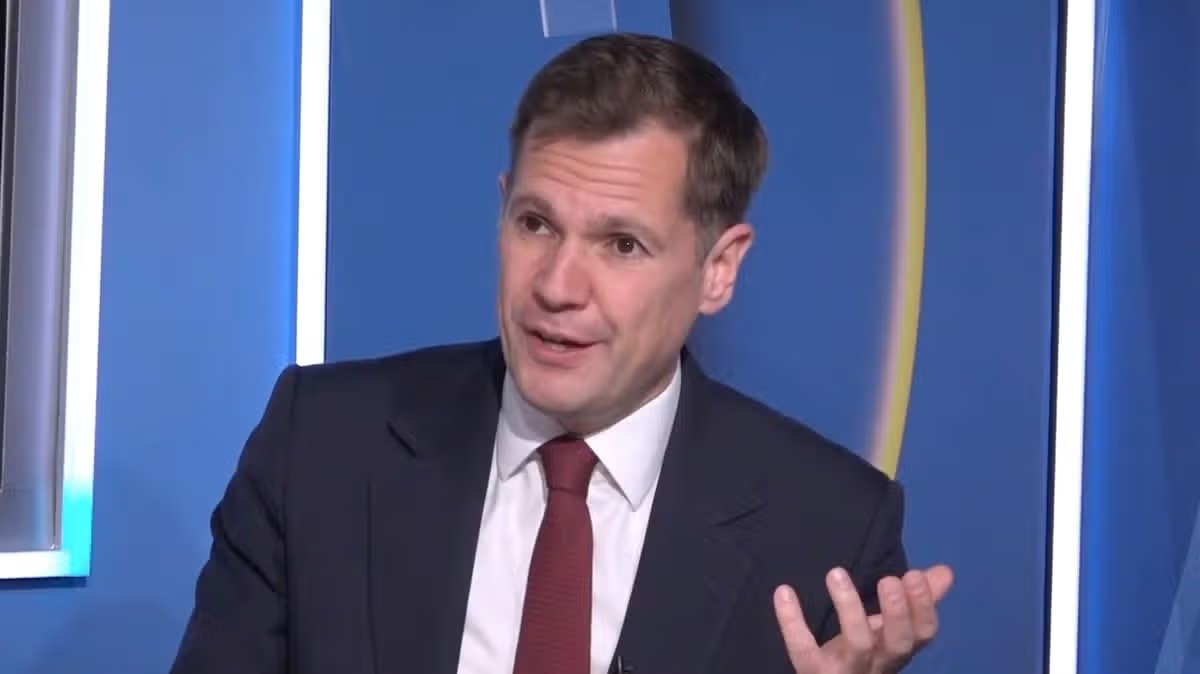
EXCLUSIVE: The Prime Minister said it was painful to see the same failures that impacted his grandmother 25 years ago when his beloved dad Roy needed care as he battled Alzheimer’s
Andy Burnham has said he is more determined than ever to fix the broken social care system after the death of his beloved father.
The Prime Minister said it was painful to see the same failures that impacted his grandmother 25 years ago when his dad Roy needed care as he battled Alzheimer’s disease. Mr Burnham’s dad, who had been living in a care home, died earlier this month aged 86.
His father’s illness meant he did not know that his son was becoming Prime Minister. However Mr Burnham later said the staff in his care home thought he had shown a flicker of recognition when they showed him the moment the PM entered No10 on TV.
Speaking to the Sunday Mirror from his No10 North office in Manchester, the PM said the experience had fuelled him further. He said: “In a word, yes. I won’t leave office without having grasped this nettle.
“I saw what happened to my grandmother. You’re going back 25 years ago now. She died in 2002, and she went through the care system, and it wasn’t good enough at all. And that really focused me on the issue.”
Mr Burnham’s gran Catherine Murray was forced to sell her home to pay for her care. He previously revealed how her wedding ring was stolen from her hand as she lay in a nursing home.
He told us that the experience had left a lasting mark, and he had tried to bring forward reforms when he was Health Secretary “so that my parents’ generation didn’t have the same experience as my grandparents’ generation had”.
The PM said: “But here I am today, having now directly, painfully, personally experienced the fact that that has happened to my parents’ generation, and not just [my parents], I’m talking about thousands and thousands of people across the country.
“That is a shameful dereliction of duty by a generation of Westminster politicians who have just shown total cowardice in relation to this issue.
“The idea that it’s too difficult. How can the care that we give from one person to another be too difficult for politics? How? I mean, that is terrible, that politics has got itself to a position where it’s so superficial and so focus group driven that it won’t take on a difficult argument and say, no we have to fix this.”
The PM said failure to fix social care will “break the NHS”, and said stretched care staff are being told to ring 999 to if there is a problem with a patient.
“You cannot fix 21st Century care needs on that basis where there’s no prevention and we’re just sending everything to hospital” he said.
“In the end, it will sink the NHS if we carry on in this way. So I’m not going to leave office having done what everyone else in my position has done, and pretty much say, ‘well, I’m not going to deal with this. It’s too difficult. It’s not a priority.’
“It is a priority for me, and I will face it. And it may make me unpopular, but I’m going to do it.”
Social care will feature in Mr Burnham’s conference speech on Tuesday, where he will address party faithful as Labour leader for the first time.
“It’s not the case that there’s a complete detailed plan yet,” he said. “I will just go out and make the argument in a front foot way, talking about the experience that I’ve been through, that we’ve been through.
“The thing I would say is, my dad could not have been cared for better by the people in the care home where he was, or you know when he was at home, amazing people and some of them from all parts of the world.
“The fact that they do it in a broken system on poverty pay just makes them all the more remarkable that they do that for other people’s parents day in, day out.
“When you when you’re living it and when you’re looking at it through the eyes of your own parent, you look at what they do in a different way because you really observe it.
“It’s so moving when you see how they do what they do, and it makes me angry about modern politics actually, that they are invisible to most politicians what they do in their jobs every day, and it just cannot be possibly justified in any way, shape, or form.”
Under the slogan “Hope Again”, the PM will seek to fire up Labour troops at a moment when the party’s electoral fortunes appear to be on the up.
He said: “We are going to set out what we believe is a path for the country to feel more hopeful, have a sense of belief and direction.
“It can’t be done overnight. But it is about being honest about where we haven’t gone right in the right direction in the past, and then saying clearly to people, these are the things we will do to put Britain on the right path, to let the country believe again, let people have hope again.”
But Mr Burnham faces mounting challenges to deliver on his plans to ease the cost of living, as the economic picture darkens ahead of a high-stakes Budget next month.
The PM wouldn’t be drawn on his plans to balance the books but insisted Labour’s manifesto commitments on tax still stand, which rule out hikes to VAT, income tax and national insurance for working people.
And he signalled there would be more help to come on the cost of living.
“I’ll be pointing to the fact that there’ll be a cap on bus fares across England for the whole of 2027, two pound cap. That helps, you know. So the thing is, hope comes from doing the small things as well as the big things.”
He said he wanted to do all he can to give breathing space to business too, saying: “I realise it’s a hard climate for people out there. But I think all of that can bring a sense of hope. We’re not promising people the earth, but you’re showing there are things that can still be done, and actually beyond those first steps, there’s a direction for the country that will take us to a better place in the long term.”
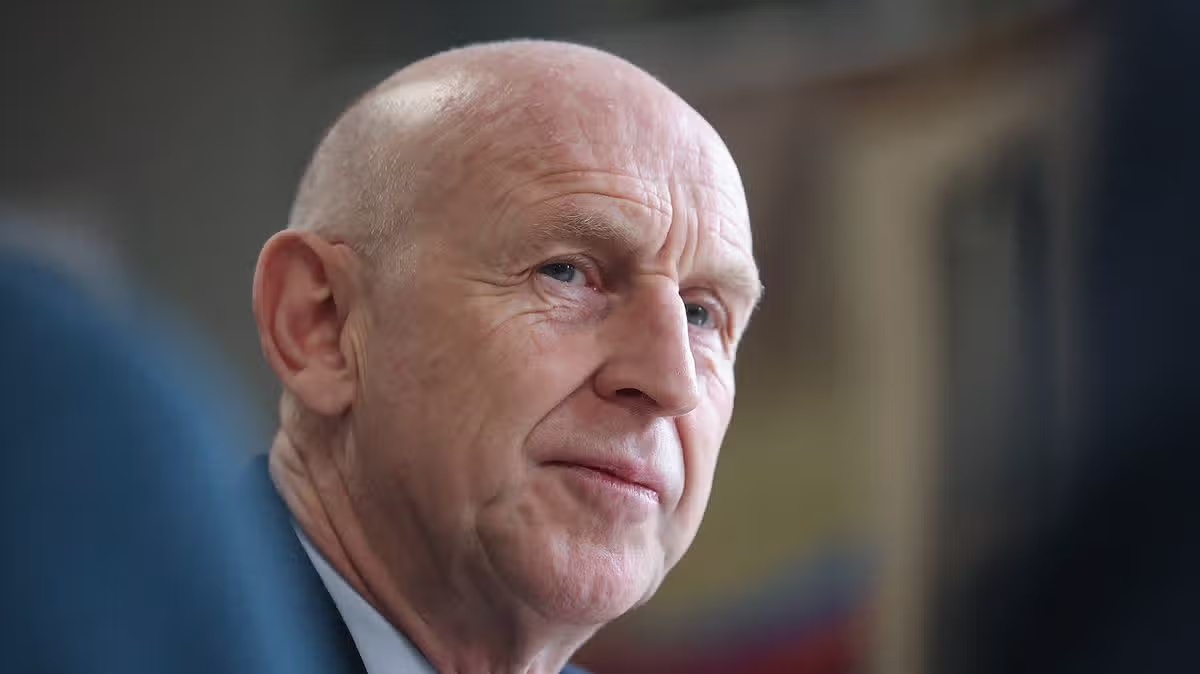
But Mr Burnham and Chancellor John Healey face a string of unenviable choices to balance the books – tax rises, public spending or more borrowing.
Asked if there could be a return to austerity, he said: “We’re obviously trying our best to make sure that we don’t go back to those days in the 2010s. The damage that was done in that period actually I think has sometimes been underestimated.
“The hollowing out of council budgets, I think, damaged growth at a local level. So alongside breathing space, we want this to be a growth promoting Budget.”
Mr Burnham will sketch out more of his vision on how to hand people more control over their lives – and the state more control of vital services.
“The country took some wrong turns in the 1980s. Things were broken up and sold off: homes, energy, water, transport, care,” he said.
“Why is Britain not in the place that it should be? How do we give people more control over their lives, the country more control over the basics? That’s the theme that I’ll be developing in Liverpool.”
Another difficult issue on his desk is the small boat crisis, and the rise of toxic far-right protests on the south coast.
The PM said: “The best thing we can do is to get the overall numbers down, and they are down. Those who want to build public unrest will focus on one issue or one day.
“But the crucial thing is to look at the big picture, and the big picture shows that boat crossings are down by around 50% between where they are now and where they were in the early 2020s.
“So massive progress has been made. I’m not saying it’s good enough. I’m not complacent about it.”
He said the gangs were being forced to change their models as the Government cracks down, but said the Home Office would be relentless in adapting.
He added: “I think it’s really important that we don’t allow those who want a narrative, they will leap on one incident or one day or whatever to suit their political purposes. What we need to do is to point to the broad picture, which is one of progress – not enough, but progress.”
Mr Burnham rubbished speculation in Westminster that he was planning to call an early general election. “There will be no early election, so people may as well forget about that,” he said. “We’re focusing on the here and the now.”