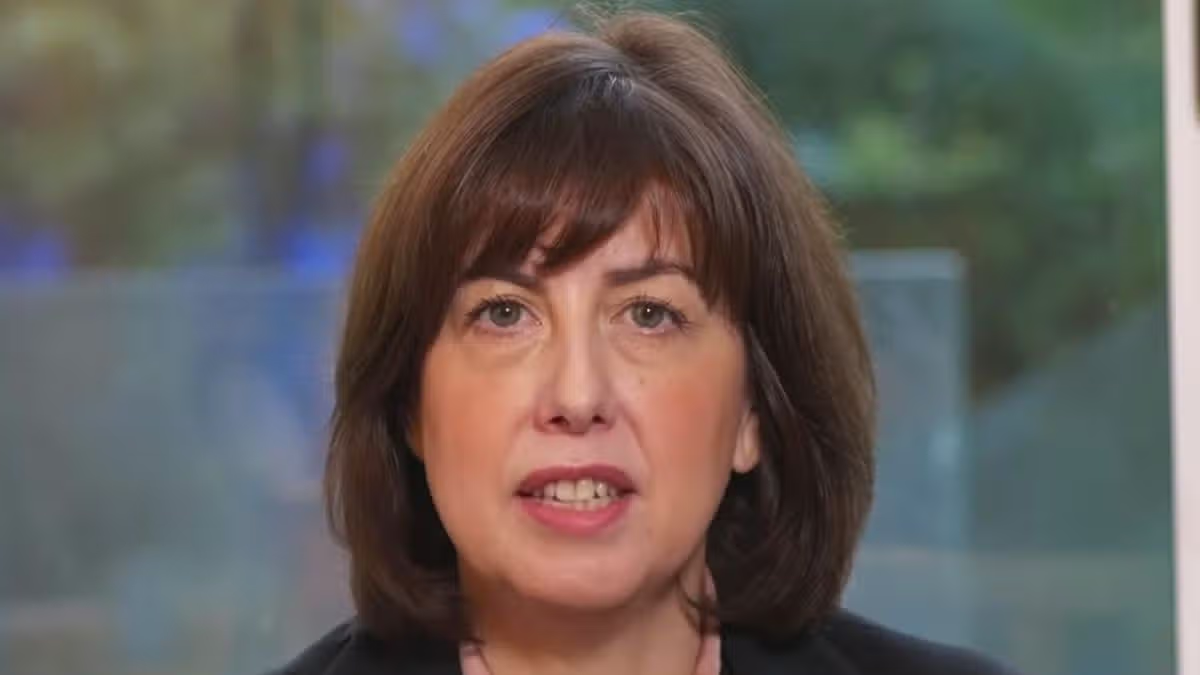
The Education Secretary, who is expected to set out her sweeping changes to the national curriculum in full on Monday, dismissed claims of dumbing down schooling

Education Secretary Lucy Powell appearing on BBC’s Sunday with Laura Kuenssberg
Lucy Powell has promised to be the country’s “tiger mum” – as she denied the biggest curriculum shake-up for over a decade will lower standards.
The Education Secretary, who is expected to set out her sweeping changes in full on Monday, dismissed claims of dumbing down schooling.
She told the BBC’s Sunday with Laura Kuenssberg: ”No-one is stronger on standards than me. I’ve got three kids myself, some might call me a tiger mum myself. I’m going to be a tiger mum for the whole of the country.” A ‘tiger mum’ typically refers to a strict mum that pushes for their child to work hard for academic success.
The curriculum reforms being unveiled on Monday are based on strengthened reading and communication skills, with a new “oracy” assessment at the end of primary school to test children’s speaking and listening skills.
To see more of the stories you love from The Mirror and to find them easily in Google then make us your preferred source. Free and easy-to-do, just click on the link here to find more from The Mirror at the top of your feed
Some 81% of non-disadvantaged pupils reached the expected standard of reading by the end of primary school in 2026, according to official stats. Only 63% of disadvantaged children hit the standard.
There will also be compulsory citizenship lessons along with digital, financial and media literacy, including classes on spotting misinformation and bias.
But Ms Powell, who is also Labour’s deputy leader, acknowledged that some material would be removed from “overcrowded” subjects. She said: “We have taken difficult decisions in some subjects – Science, Geography – particularly at GCSE where they are very overcrowded.”
Asked whether it meant less Science and Geography, she replied: “It’s not less – it’s about having the fundamental understanding that helps you apply those core foundations.”
Monday’s reforms will also see changes to the ‘Progress 8’ system used to measure school performance – giving vocational, technical and creative subjects equal status. The change is a move away from the more academic-focused EBacc system – introduced by ex-Tory minister Lord Michael Gove – which Ms Powell described as “a straitjacket for too many”
In a statement, Ms Powell added: “Every child should have strong foundations in English, maths and science – but they also deserve the opportunity to explore a broad range of subjects alongside, from the humanities and languages to creative and vocational education, that help them to discover where their talents can take them.
“For too long, education has been too narrow and the EBacc requirements became a straight-jacket for too many.
“We will finally unleash young people’s passion and potential – backed by a brilliant, new and engaging curriculum and better GCSEs that give these subjects the rigour, credibility and respect they have long lacked.
“Every child should be engaged and see a place for themselves in school that feels unmissable. This government will make sure every one of them can find a pathway to a successful future.”
Paul Whiteman, general secretary of the National Association of Head Teachers, said: “If schools are being asked to deliver new content and develop additional skills, it is vital that government has been equally bold in removing or reducing expectations elsewhere.
“Schools cannot simply be asked to do more and more. These proposals represent a significant programme of change, and their success will depend on schools being given sufficient time, support and resource to implement them effectively.”
National Education Union (NEU) chief, Daniel Kebede, told the BBC on Sunday he agreed the current curriculum was “overloaded”. He added: “The average primary child has half an hour of art a week – that is not right. So, we want to see these changes.
“However, I do have some questions for the Secretary of State. We want to see the broader curriculum, better vocational offer. But this was a government that was elected on a promise of 6,500 new expert teachers. We have 2,500 fewer in the system.”