Covid-19 Inquiry chair Baroness Heather Hallett says UK ‘effectively blind’ due to lack of tests and a contact tracing plan when pandemic struck as thousands died

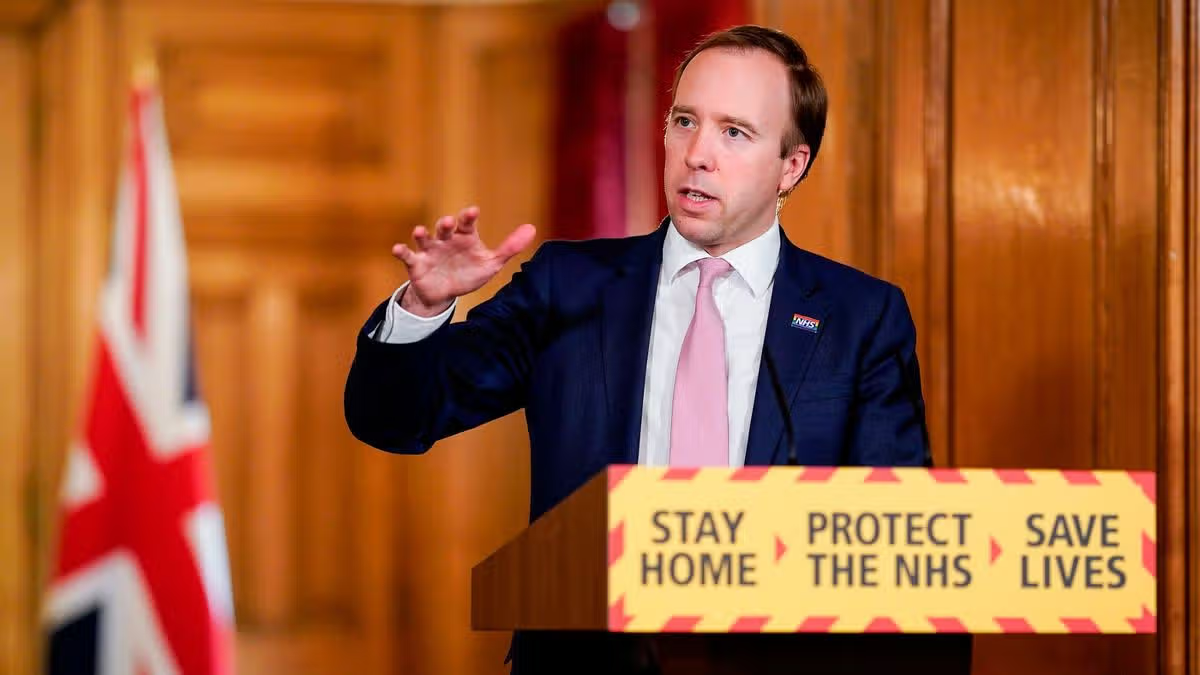
Former health secretary Matt Hancock and the Tory government set up NHS Test and Trace(Image: 10 Downing Street/AFP via Getty)
The Covid-19 Inquiry has found “too many lives were cut short” because of the Tories’ botched contact tracing system during the pandemic.
The biggest public inquiry in British history says the country was “effectively blind” when the virus struck before contact tracing was effectively privatised and failed to reach most contacts of infected people.
Inquiry chair Baroness Heather Hallett said the country was “simply not prepared” to test, trace and isolate enough people to protect the population before former Prime Minister Boris Johnson abandoned contact tracing due to lack of tests.
Lady Hallett said: “When Covid-19 arrived in the UK in January 2020, the UK was simply not prepared to deliver test, trace and isolate systems at the scale or speed required… For the first three months of the pandemic, Covid-19 spread across the country virtually unchecked.
“Too many lives were cut short. Too many died without the comfort of their loved ones around them. Countless families were left grieving.
“Millions more endured profound disruption to their daily lives, distressing separation from their families, isolation, deteriorating mental health and severe financial strain. Some are still living with the devastating consequences today.”
The virus emerged at the start of 2020 and Mr Johnson and his Health Secretary Matt Hancock abandoned contact tracing in March due to lack of tests, when they announced an end to the “contain” phase and a move to the “delay” phase.
NHS Test and Trace was later set up in May 2020 led by Tory Peer Baroness Dido Harding costing £25 billion in England, which was largely paid to outsourcing firms Serco and Sitel. Instead of beefing up established contact tracing teams at local councils and universities, the body used agency call centre staff who were largely not medically trained. It meant fewer than half of close contacts of people with Covid-19 were able to be reached in England as the virus spread and tens of thousands died.
Eventually national lockdowns were announced to halt the deaths and stop the NHS being overwhelmed.
Lady Hallett said: “When they realised the scale of the crisis, the four governments of the UK invested considerable time, effort and resources in developing a scaled-up system of test, trace and isolate measures that could meet the demands of a pandemic.
“Once established, it was extremely effective however their initial efforts were hindered by the lack of planning, a lack of knowledge of the existing testing capabilities of the private and public sectors, and a failure to work with them and local authorities with expertise in contact tracing.”
The report compared the initial contact tracing response in Northern Ireland – which used existing public health laboratories working from a central office. Its contact tracing specialists were able to reach 92% of people who tested positive for Covid-19 by June 2020.
In contrast, in England existing public health teams at local councils were stood down early in the pandemic as Baroness Harding set up NHS Test and Trace. Its work was outsourced to firms Serco and Sitel which quickly recruited 15,000 call centre workers, many of whom were on the minimum wage.
In England by June 2020 just 42% of close contacts of people with Covid-19 were being reached, rising to 47% in July 2020 and falling to 44% in August 2020.
In evidence to the inquiry, Prof Philip Banfield, council chair of the British Medical Association, said: “We couldn’t understand why the Government was apparently abandoning basic public health protection measures. Our local public health doctors were prepared for a pandemic. This is their bread and butter.
“We seemed to have abandoned that first principle of control of an infectious outbreak by trying to work through testing and isolating and making sure that you can support people to do that.”
The report acknowledged that England has a much larger population than the devolved nations and therefore what is suitable for Northern Ireland, Scotland or Wales – which did not outsource contact tracing – may not be suitable for England. It said that in Northern Ireland they were able to utilise the advantages typically associated with local teams with existing expertise in contact tracing.
As the death toll mounted and in response to public pressure, local council teams were eventually used by NHS Test and Trace to reach people. With the help of these specialists 74.7% of the identified contacts of an infected person were successfully traced in September 2020.
Baroness Harding admitted to the Inquiry that “with the benefit of hindsight, you’d do it [use local expertise] earlier.”
Office for National Statistics data shows there were 81,795 registered deaths in England and Wales during 2020 which involved Covid-19. Of these 73,766 had Covid-19 listed as the underlying cause on death certificates.
A Public Accounts Committee report published in October 2021 concluded that NHS Test and Trace had “not achieved its main objective to help break chains of Covid-19 transmission and enable people to return towards a more normal way of life”. By June 2021, the service had sent out 691 million lateral flow tests, but results had been registered for 14% of them, the report stated.
The module 7 report concluded that “the optimal model of contact tracing for a pandemic… combines national capability with local expertise” so that local councils can “contribute relevant knowledge and expertise”. It is vital that such a system with surge capacity is planned, it said.
Baroness Harding is now demanding that the government sets up a “robust and scalable test, trace and isolate system” which she said will be “fundamental to saving lives and reducing suffering” when the next pandemic hits.
The latest module of the inquiry focusing on the UK’s attempts to “test, trace and isolate” is the seventh of ten to be published to help prepare for the next pandemic.
Baroness Hallett’s recommendations in module seven were:
- monitoring the UK’s testing capabilities to ensure that the diagnostics sector is used effectively;
- ensuring that plans are in place to deliver manual contact tracing on a large scale;
- developing a UK-wide digital contact tracing tool;
- ensuring that local plans are in place to deliver practical support to communities if self-isolation is required;
- ensuring that plans are in place for financial support if self-isolation is needed;
- planning for the use of international border control measures;
- developing aligned communications campaigns about testing, tracing and isolation, to avoid confusion or ambiguity;
- improving data collection and evaluation of testing, tracing and isolation so that the impact on the public and levels of adherence can be monitored effectively; and
- producing a single UK-wide system for testing, tracing and isolation.