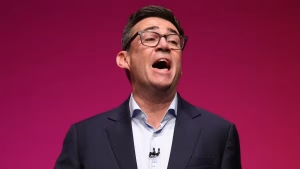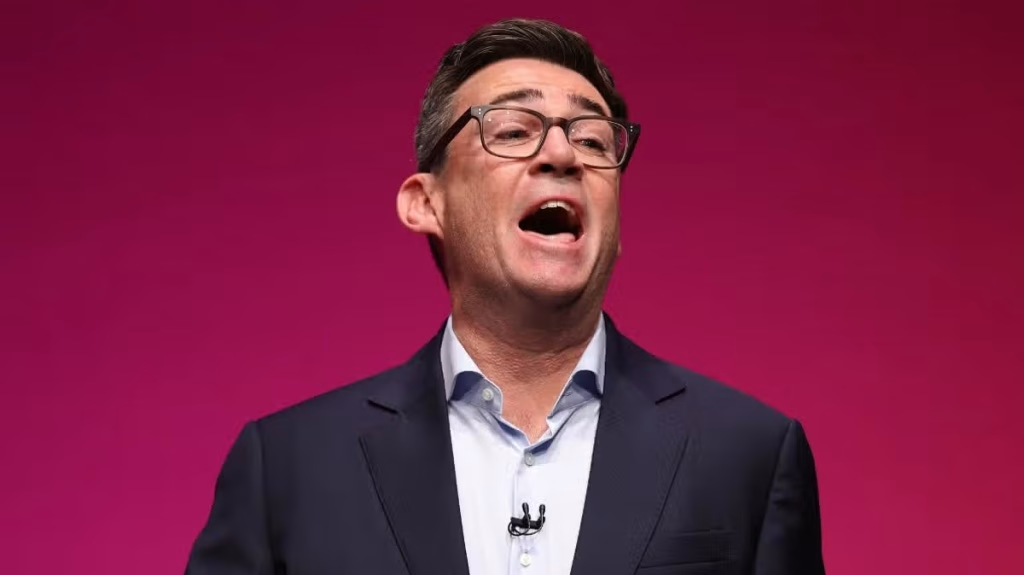
Andy Burnham used his Labour conference speak to announce a watering down of the pension triple lock to fund a planned revolution in social care

Andy Burnham has made a big gamble by tweaking the pension lock to fund an overhaul of social care(Image: ADAM VAUGHAN/EPA/Shutterstock)
Andy Burnham has grasped the nettle and announced a future Labour government would end the state pension triple lock.
To recap, the triple lock – introduced in 2010 – promised that the pension would rise every April by whichever was highest out of inflation, 2.5% of average earnings. However, the pledge has proven far more expensive to maintain than expected, with the government set to spend £154billion this year on the state pension.
This April saw the state pension increase by 4.8%, as it was in line with average earnings. The full rate rose from £230.25 to £241.30 a week, while the full basic state pension increased from £176.45 to £184.90 a week.
What has Burnham announced?
The PM used his conference speech to confirm the triple lock would effectively become a double lock from 2030, with the earnings link dropped. The state pension will continue to rise by at least the rate of inflation or 2.5%.
The money saved would be used, Burnham claimed, to help fund adult social care reforms in England. Burnham said the state pension would rise in line with average earnings only in the long term, and in a less predictable way.
How will it go down with voters?
That’s the huge gamble Burnham has made, with the PM hoping the public get the need to curtail the scale future rise in pension payouts in order to free up the cash to find a National Care Service. To be clear, the state pension would still rise under a double lock, just not as much as theoretically under the triple lock.
And the overall savings for individuals could be huge if, according to the rhetoric, older people aren’t forced to sell their homes or raid their savings to pay for care. However, there will be plenty of critics lining-up to slam the breaking of the link, and potentially among Labour’s union base. Burnham’s decision could prove one of the big calls of his Premiership, and will be a defining issue going into the next general election.
What has been the reaction?
The Institute for Fiscal Studies called it a “major and welcome change”, as dropping the earnings link removed what it said was the most expensive and “unjustified” part of the triple lock. Jonathan Cribb, deputy director at IFS, said: “It is great news that Andy Burnham has neutered the worst element of the triple lock.
“Goodbye to the unsustainable ‘ratchet’ effect. State pensions will still rise, but more sustainably. Better reforms were available, but this one is a big improvement. It will not, however, be the answer to funding universal social care.”
But he warned: “It is hard to know how much this reform will save the Exchequer; savings are likely to be relatively small in the first few years, but rise substantially over time. We should not expect this reform to save enough that it could fund universal social care in the next parliament.
“To give a sense of the scale of possible future savings: if the new policy had been in place since 2011, state pension expenditure this year would £9billion lower than it is today, more than halving the £16billion annual cost in 2026/27 of having retained the unreformed triple lock for the last 15 years. For pensioners, the reform means that state pensions will still rise in real terms over time but more slowly than under the current system, and in the long run their pensions will keep pace with growth in employees’ average earnings.”
Caroline Abrahams, charity director at Age UK said: “Good social care support that you can depend on is certainly critical for older people if they’re to live decently in retirement, but so too is financial security. For a generation, the triple lock has given older people confidence that the value of their state pension won’t be eroded in an uncertain and volatile world, and now the government wants to change it from 2030, when their manifesto pledge expires.
“Pensions policy is notoriously complex so we postpone judgment on the overall impact of their proposed reform until we can scrutinise the detail. However, much will depend on where we are by 2030 , including what level the state pension has reached by then.”
Harry Quilter-Pinner, executive director at think tank the IPPR, said: “If reforming the triple lock can help fund a National Care Service, that deserves serious consideration. Ageing is going to become by far the biggest source of pressure on the public finances in the future. We need to confront that reality fairly, rather than continuing to load more of the cost on to younger and working-age generations.”