Anxious parents who have shielded their children from smartphones and tablets have warned the newly digitised Reception Baseline Assessment is at odds with screen time guidance for under 5s

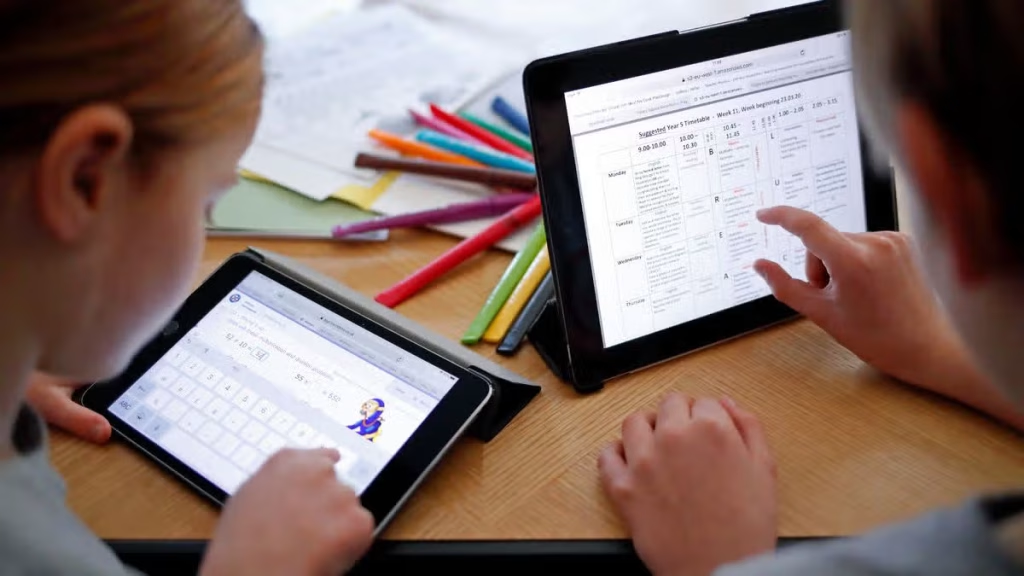
The Reception Baseline Assessment became digital in September last year(Image: Getty Images)
Thousands of parents have sounded the alarm over screen time in schools after compulsory tests for Reception-age kids were moved to touchscreen devices.
Anxious mums and dads who have shielded their children from smartphones and tablets have warned the newly digitised Reception Baseline Assessment (RBA) is at odds with the Government’s screen time guidance for under 5s.
In a letter to early education minister Paul Waugh, some 2,700 parents wrote: “Like us, many parents have sought to minimise or entirely exclude smartphones and tablets from their children’s early lives.
“As a result, these children have not been routinely exposed to touchscreen technology and remain largely or entirely unfamiliar with it. We believe this is a good thing, supportive of their health and happiness – children of four or five years should not need to become familiar with touchscreen devices.
“Parents should not be forced to require their children to take the digital version of this assessment, and teachers should not be forced to administer the digital assessment in circumstances where parents have raised well-founded legitimate concerns about a child using touchscreen devices in circumstances which contravene the DfE’s own guidance on screen use.”
The letter calls for the Department for Education to update its RBA instructions to allow schools to request and use paper-based packs for any child whose parents don’t want them to use a touchscreen device.
Official early years screen time advice in March recommended children aged two to five should only watch one hour of screen time a day.
It said adults should co-engage, prompt, and discuss when screens are used with young children, as experts say talking, asking questions and engaging with the content is linked to better cognitive development than solo screen use.
Yet, experts warn the guidance for the RBA test – a statutory assessment the first 6 weeks of starting reception – suggests teachers shouldn’t guide or prompt kids even if they are visibly struggling, or confused.
Research by Leeds Beckett University in July found that every child observed taking the newly changed RBA – which became digital in September last year, showed visible signs of distress, with teachers powerless to intervene.
As well as parents, education and early years experts have criticised the digitisation of the RBA, with a separate letter raising concerns sent to Education Secretary Lucy Powell earlier this month.
It was backed by Beatrice Merrick, chief executive of the British Association for Early Childhood Education, Daniel Kebede, general secretary of the NEU teaching union, and representatives of the UCL Institute of Education.
Teachers’ union the National Education Union has said it does not believe the test “supports learning” and has raised “concerns about increasing screen time for young children”.
A survey by the NEU of 970 reception teachers last year found two thirds (67%) think the assessment hasn’t improved by becoming digitised, with 46% “strongly” believing so.
Jane Rowland, from the campaign group SafeScreens, told The Mirror: “Parents who have carefully limited their children’s exposure to screens are now watching their children’s very first assessment at school undermine that effort, and being told there’s no choice in the matter.
“Devices should be banned from the Reception Baseline Assessment altogether. Ministers are asking four-year-olds to do the one thing their own experts say they shouldn’t.”
Dr Mandy Pierlejewski, from Leeds Beckett University who undertook the study, said: “The Reception Baseline Assessment is a wholly inappropriate way to assess young children. Our research found that the test causes stress, is inaccurate and requires a level of digital literacy which four-year-olds do not and should not possess.”
A Department for Education spokesperson said: “This short assessment helps teachers understand children’s starting points so they can support learning from day one but it does not require a screen to be used for every part.
“Carried out with a teacher, a child would respond in a range of ways – including verbally, using physical resources such as toy bears and, for some questions, interacting with a screen.
“This is in line with our guidance, which helps parents support healthy, balanced screen use alongside play, reading and conversation.”