Alternative fur Deutschland (AfD) has fallen short of the outright majority needed to govern alone – but it secured 43.8% of the vote compared with the conservative CDU’s 17.2%

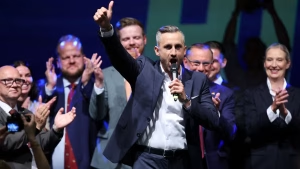
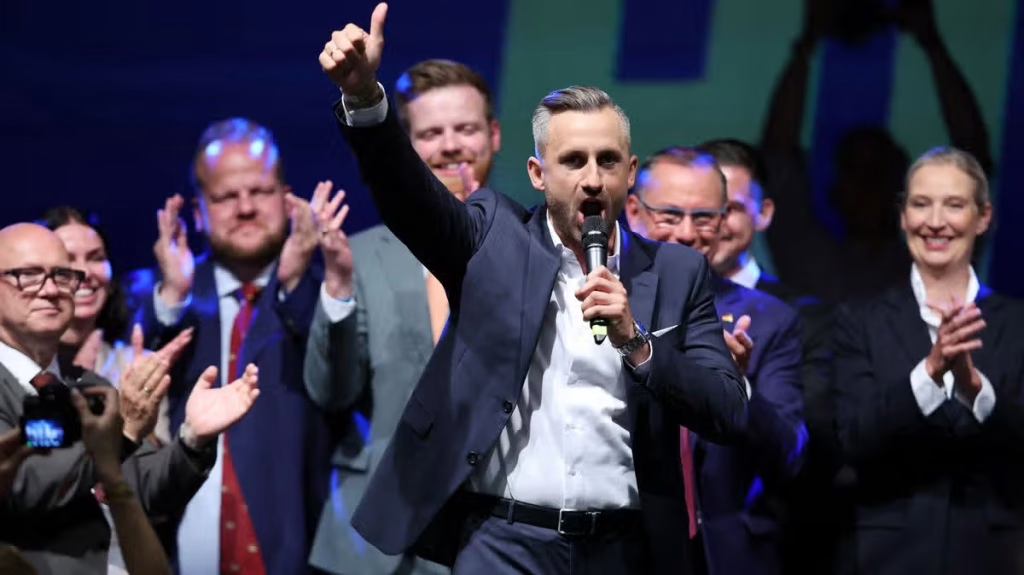
Ulrich Siegmund, far-right Alternative for Germany (AfD)’s main candidate in the Saxony-Anhalt state election, gestures as he addresses supporters at the AfD’s election party(Image: AFP via Getty Images)
A far-right party won a decisive victory in Germany’s eastern state of Saxony-Anhalt – and warned the rest of Europe that it was the shape of things to come.
Alternative for Germany (AfD) has fallen short of the outright majority needed to govern alone. But it crucially secured 43.8% of the vote compared to the conservative CDU’s 17.2%, and predicted a repeat of that success in the next two state elections.
AfD state leader Ulrich Siegmund described the result as “sensational” and said the party had won a mandate to govern.
Poland’s centre-right Prime Minister Donald Tusk warned: “In Poland, only idiots and traitors can rejoice at the triumph of the AfD”.
The AfD’s deputy leader in the German Parliament, Beatrix von Storch hit back, saying: “Our detractors need to wake up to what is happening in several other European states.
“The Conservative Party will disappear from the landscape, as has happened in Italy and is also happening in the UK and may happen in France with Marie Le Pen.
“The Conservative Parties may stop existing because they do not realise that. People realise the issues dogging their lives. They don’t care about people telling untrue stories about us.”
Among the AfD’s policies is a highly controversial plan for “remigration”, which is widely understood to mean mass deportations of migrants, although the party says it refers to deporting criminals and those in the country illegally.
No far-right party has controlled a German state since World War Two, and governing at state level would mean powers over policing, local education and culture.
Saxony-Anhalt has a small population of 2.1m. Germany’s intelligence assessed the state’s AfD chapter as “right-wing extremist.” Siegmund, 35, rejected that claim.
Along with joint national leaders Alice Weidel and Tino Chrupalla, he was overjoyed as exit polls revealed they were on track to score more than double the party’s result in 2021.
Siegmund, 35, a former salesman and marketer, has used social media to reach young voters and enjoyed a rapid rise to the top. He turned up to vote on a moped with his wife as a pillion passenger. With 880,000 followers on TikTok, he convinced 150,000 previously disillusioned ‘non-voters’ to support his party, despite its reputation for extremism.
US President Donald Trump posted a screenshot of the German TV projection on his Truth Social platform, and then Russian presidential envoy Kirill Dmitriev took a screengrab of Trump’s post and praised a “historic win for the pragmatic AfD”.
The AfD is currently heading for 39 seats in the 83-seat state parliament instead of the 42 needed for an outright majority. Siegmund has so far refused to lead a minority government, even though the party’s national leaders see it as a possibility.
“If necessary there’ll just be new elections, then we’d just get 50 or 55%,” said Siegmund, while stating he was prepared to work with individual MPs or a party.
The spotlight now falls on the left-wing populist BSW, which scraped into parliament but is set to win five seats and could help Siegmund come to power. The BSW is also tough on migration and backs importing Russian gas, and it has kept the door open to working with the AfD.
AfD has not only dominated the election campaign, it is emerging as the dominant force in Germany and its supporters believe they are on the march. Turnout in Saxony-Anhalt was particularly high at 77.8%, and AfD supporters in Magdeburg praised Siegmund’s success in winning over voters.
The head of the Jewish community in Munich and Bavaria, Charlotte Knobloch, 93, a Holocaust survivor, said: “On days like this I find it hard to recognise my homeland any more.”
One of the AfD’s top figures in Saxony-Anhalt, Hans-Thomas Tillschneider, has also been criticised for his approach to Russia. When asked why he had a Russian army mug in his office, he said it was just a souvenir, and “it’s not our war”.
Thorsten Frei, the CDU leader in the Bundestag, warned the result was a “turning point for our country”. His boss Friedrich Merz, the chancellor, is now facing questions about his own future.
His approval ratings are said to be between 13 and 16 percent; the lowest for a sitting chancellor since records began.